


Alberto Bonillo Losa, Trombone; and Thomas Steinwender, Horn
(Click on the image above for the concert video.)
The beloved Christmas Carol Silent Night was written by a young Austrian priest, Joseph Mohr, in 1816 after a walk through his quiet, snow laden town – a town that was at peace. It was first performed on Christmas Eve, 1818, at St. Nicholas Church in Oberndorf as Stille Nacht Heilige Nacht, with Mohr singing the lyrics and playing the guitar to a score written by Franz Xaver Gruber, the choir director.
A copy of the six-verse song was taken to his home village by an organ builder and repair man working at the church. It was subsequently shared across Northern Europe by two families of folk singers from the village. The carol was performed for the King of Prussia in 1834 and debuted in the United States outside Trinity Church in New York City in 1839.
Silent Night has been translated into 300 languages and was even sung simultaneously by soldiers on the battlefield in French, German and English on Christmas Eve 1914.
For decades, the original manuscript was lost, and it was speculated that it was written by Hadyn, Mozart or Beethoven. However, in 1994 the original manuscript was discovered in Mohr’s handwriting with Gruber noted as the composer.
Passacaglia for Violin and Cello in G Minor

Passacaglia for Violin and Cello in G Minor
after Georg Friedrich Handel's Suite for Harpsichord No. 7, adapted by Johan Halvorsen
(Click on the image above for the concert video.)
Georg Frideric Handel's (1685-1759) Harpsichord Suite No. 7 in G minor (1720) is a set of baroque instrumental compositions consisting of six movements. The last movement is a passacaglia which has become well known as a duo for violin and viola or cello, arranged by the accomplished Norwegian violinist and conductor Johan Halvorsen (1864-1935). A ‘passacaglia’ derives from the Spanish pasar (to walk) and calle (street). While it is first referenced in Spanish literature in 17th century Spain as a strummed interlude between instrumentally accompanied dances or songs, the first written examples are found in Italian sources at the beginning of the 1600s as simple, brief sequences of chords outlining a cadential formula.
Johan Halvorsen was the conductor of the National Theatre in Oslo from 1899 to 1929 and conducted over 30 operas as well as theatre music. He wrote incidental music for many plays and in retirement, he composed his three symphonies and two well-known Norwegian rhapsodies.
Among his best-known works today is his Passacaglia in G Minor for violin and viola (1893) based on Handel’s Harpsicord Suite No. 7. The last movement, Passacaglia, comprises sixteen variations over a groundbass (a bassline that is continually repeated throughout a composition). Halvorsen uses the same groundbass and similar opening variations but presents extended techniques for string instruments to create his own virtuosic set of variations.
Halvorsen’s work contains distinctly modern features, such as tempo changes, extended techniques, and eight-bar sections not employed in classical music until the romantic era. Handel’s Passacaglia does not include any variation in tempo, while Halvorsen includes five distinct tempo changes and a stringendo (acceleration forward), as well as many ritardandos (gradual decreases in tempo) throughout the piece. Additionally, he changes the pitch to different octaves – including a lower octave to create a bass-like accompaniment. He uses extended techniques (unconventional methods of playing to obtain unusual sounds). For instance, he calls for ponticello (sliding the bow over the bridge); artificial harmonics (pressing the left hand first finger, down while the fourth finger lightly touches the string); and saltando (playing each note staccato in one motion, by bouncing the bow off the strings). These unique features of Halvorsen’s work in comparison to Handel, are considered to distinguish Halvorsen’s piece as a masterpiece of the early 21st century.
Suite No. 6 in D Major for Cello

(Click on the image above for the concert video.)
Johann Sebastian Bach (1685 – 1750) is German composer and musician of the late Baroque period. Throughout the 18th century, Bach's music was appreciated mostly by his colleagues who recognized his virtuosic abilities, and distinguished connoisseurs. A Bach Revival started from Mendelssohn's performance of the St Matthew Passion in 1829. Soon after that performance, Bach became regarded as one of the greatest composers of all time, a reputation he has retained.
Bach most likely composed his Six Suites for Cello between 1717 and 1723 when he served as the Kapellmeister in Köthen. While they are some of the most frequently performed solo compositions for the cello, the Suites were little known and rarely performed until the early 20th Century when they were performed and recorded by Pablo Casals who, at age 13, had found them in a thrift shop in Barcelona in 1889. Casals became the first to record all six, with Suites 2,3,4 and 5 recorded in London in 1936 and Suites 1 and 6 in 1938 in Paris.
Suite No. 6 in D Major was composed for a cello “a cinq cordes” – with five strings - to accommodate the extended arpeggios and high range of the composition. This instrument can be tuned in one of two ways - with a high ‘e’ or a low E. This Suite is very difficult on a traditional cello. The structure of Suite No. 6 includes a Prelude, Allemande, Courante, Sarabande, two Gavottes and Gigue.
When composing, Bach exploited the capabilities of an instrument to the fullest while keeping the core of such music independent of the instrument on which it is performed. The music fits the instrument, pushing it to the full scale of its possibilities and requiring virtuosity of the player as is seen in his compositions for the violin, the cello and keyboard music.
For the Cello Suites, the virtuoso music seems tailored for the instrument, yet like other Bach compositions, the Suites have since been transcribed for many instruments, including the violin, double bass, mandolin, piano, marimba, flute, horn, saxophone, clarinet, bassoon and trumpet.
Gran Duo for Clarinet, Contrabass, and Piano by Giovanni Bottesini

(Click on the image above for the concert video.)
Giovanni Bottesini (1821 – 1889) is a too often overlooked versatile musician whose talent was well recognized by his contemporary peers and audiences. Rossini is said to have declared, “Bottesini is the most well-rounded talent that we have in Europe today.” On the 200th Anniversary of his birth, ‘Gran Duo for Clarinet, Contrabass, and Piano’ shines a light on his talents. He was considered a virtuoso performer on the bass; a composer of operas and other forms of chamber music as well as the bass; and was an internationally renowned conductor of his time.
Bottesini was born in the Northern Italian town of Crema to a musical family. His early musical education was guided by his father, a clarinetist and conductor who encouraged his singing in local choirs and his playing the timpani in local orchestras while also learning to play the violin. In 1835 he applied for admission to study at the Milan Conservatory. Undeterred by the fact they only had scholarships to offer in the bassoon and the double bass, he took a quick course in playing bass and managed to win the audition. In music lore it is said that realizing how badly he had played and yet still won the audition, he allegedly said “I know, my dear sirs, that I played the wrong notes. But once I’ve learned where to put my fingers, that won’t ever happen again.” Proving he was a quick study, two years later, critics called him ‘The Paganini of the Double Bass’ and audiences were enthralled with his virtuoso playing and the sounds he elicited from his instrument. “Under his bow, the double bass groaned, sighed, cooed, sang, quivered, roared — an orchestra in itself with irresistible force and the sweetest expression,” reported a critic, describing Bottesini in concert. “The aristocratic court audience was ecstatic. Applause and calls for encores exploded down the disorderly rows at every bar.…Supported by his great wooden sound-box, Bottesini leant over his instrument like a conquering hero.”
A legend persists that he discovered the three-stringed double bass he played laying under some trash in a puppet theatre. Bottesini played using the overhand, French bow style which is considered more difficult to gain leverage of the bow but easier to develop more sophisticated stroke technique. His use of the French bow inspired others to move away from the German bow and adapt to playing with the French bow instead.
Bottesini traveled extensively as a conductor given the time and difficulty in European and intercontinental travel in the mid 19th century. He premiered his first opera, Cristoforo Colombo, in Cuba, played concerts from Russia to Mexico and everywhere in between and conducted opera seasons in Paris, Palermo, Barcelona, Madrid, and throughout Portugal. He conducted the world première of Verdi’s Aida, in Cairo on December 24, 1871.
As expected of a virtuoso, he wrote numerous compositions for the double bass including his ‘Grand Duo’ which was originally written for two basses and an orchestra and has been transcribed to include both a violin and a clarinet instead of one bass and for the piano as well as orchestra. While only one movement, the piece has a variety of tempos and timbres with long duets that are reminiscent of works by Bellini and Rossini when writing for their singers.
Concert-Walzer for Four Violoncelli in D Major

(Click on the image above for the concert video.)
Wilhelm Fitzenhagen (1848-1890) was the son of a court musician for the Duke of Braunschweig in the small German town of Seesen, in lower Saxony, where in 1836 Heinrich Steinweg (later Henry Steinway) built his first piano. His father made sure his son had serious musical training from an early age and by age 5 he could play the piano, the violin, and the cello and could fill in on wind instruments in the Duke’s band when necessary. The Duke released him from his military service at 17 and supported his studies with Friedreich Grützmacher, a highly respected virtuoso cellist. At 20, Fitzenhagen joined the Dresden Hofkapelle (now Staatskapelle) and began a solo career. After impressing Franz Liszt at the 1870 Beethoven Festival in Weimar, Liszt attempted to entice him to join the orchestra, but Fitzenhagen had already accepted a position as a professor at the Imperial Conservatoire in Moscow – a position he held until his death in 1890. Once in Moscow, and largely self-taught, he began composing, earning praise regarding his fluent ‘use of poetical musical language, and thematic concision, and ample use of declamatory instrumental style’.
Fitzenhagen soon established himself as one of the finest cellists in Russia. He quickly became acquainted with Tchaikovsky and beginning in 1871, was selected to perform the first three of Tchaikovsky’s string quartets and his piano trio of 1882. Tchaikovsky dedicated his Variations on a Rococo Theme, Op. 33 for cello and piano, which he completed in January 1877, to Fitzenhagen. Tchaikovsky sent him the manuscript for his comments and Fitzenhagen boldly made a number of changes in the order of the variations and discarded the last variation altogether. Fitzenhagen was emboldened after performing his version at the Wiesbaden Festival in June 1879 where, as he relayed to Tchaikovsky in a letter “I produced a furor with your variations. I pleased so greatly that I was recalled three times, and after the Andante variation (D minor) there was stormy applause. Liszt said to me ‘You carried me away! You played splendidly!’ and regarding your piece he observed: ‘Now there, at least is real music’.” When his publisher asked what Tchaikovsky was going to do about the changes, he replied ‘The Devil Take it! Let it stand as it is!’ Fitzenhagen’s changes from 1878 were retained and became part of standard repertoire.
Wilhelm Fitzenhagen wrote more than sixty works for the cello including four concertos, a suite for cello and orchestra, a string quartet and numerous salon pieces. In each of the concertos, all four cellos are asked to play at their highest registers and his composition is so advanced that one can hardly tell there are four cellos playing rather than a standard string quartet.
The Sorcerer's Apprentice

Johannes Schneider on the vibraphone
(Click on the image above for the concert video.)
Paul Abraham Dukas (1865 – 1935) was a French composer, critic, scholar, and teacher. His musical talents emerged at age 14 when he began to compose. He entered the Conservatoire de Paris at 16 to study piano, harmony, and composition. After compulsory military service he began a career as a composer and music critic. Dukas was a perfectionist and consequently, he never finished or destroyed many of his compositions. His Symphony in C Major, his Piano Sonatas, his Ariane et Barbe-Bleue (Ariane and Bluebeard) and his oriental ballet, La Peri, received favorable reviews, but he is best known for his symphonic adaption of Geothe’s poem The Sorcerer’s Apprentice (‘Der Zauberlehrling‘), which eclipsed the popularity of the poem itself, even before its inclusion in Walt Disney’s film Fantasia in 1940. In his later years he taught composition, encouraging students to write ‘from the heart, not from the head‘. During an era when French musicians were divided between conservative and progressive factions, he followed neither and had the friendship and respect of both. His extensive knowledge of the history of European music and his experience as a music critic informed his teaching to the benefit of his students.
The Sorcerer’s Apprentice (‘Der Zauberlehrling‘) is a poem in fourteen stanzas written by Johan Wolfgang Goethe in 1797. Paul Dukas composed a symphonic adaption 100 years later, in 1897. His composition was featured in Walt Disney’s 1940 animated film Fantasia, leading the music and the poem to become well known outside the concert hall.
The poem tells the story of an apprentice sorcerer being left alone to perform his chores by an old sorcerer. Tired of having to fetch water with a pail, the apprentice enchants a broom to do the task for him using magic in which he is not fully trained. The floor is soon awash with water and the young apprentice realizes he does not know the magic needed to keep the broom from bringing more water. The apprentice uses an axe to split the broom in two in hopes of stopping it, but that only leads to each piece becoming a full broom, each of which continues to bring pails of water. Soon the room begins to flood. The old sorcerer returns just in time and quickly breaks the spell, admonishing his young apprentice that only a master should invoke such powerful spirits.
The Miramba and the Vibraphone
The Marimba, also called “marimbaphone” or “balafon”, is a percussion instrument of African origin similar to the xylophone and vibraphone, that is also quite popular in Latin American countries. The marimba can have up to 5 octaves. The two rows of plates are provided chromatically, as in keyboards. Rosewood planks are tuned and arranged in order of height, and resonant metal tubes are mounted perpendicularly under the plates to reinforce and prolong the sounds. The musician uses rods made of wood to produce louder sounds while rubber rods produce softer sounds. The words “rim” and “ba” come from a local language spoken in Mozambique and Malawi.
The Vibraphone is quite similar to the marimbaphone. The sounds, however, are produced by metal blades, rather than rosewood plates. Under each metal blade there is a resonance tube, at the end of which a vibrator is mounted, in the form of a flap attached to the tube. With a foot pedal the valves can be rotated, giving the characteristic sound of the instrument. The vibraphone has often been used by jazz bands since the 1920s.
A Musical Surprise!
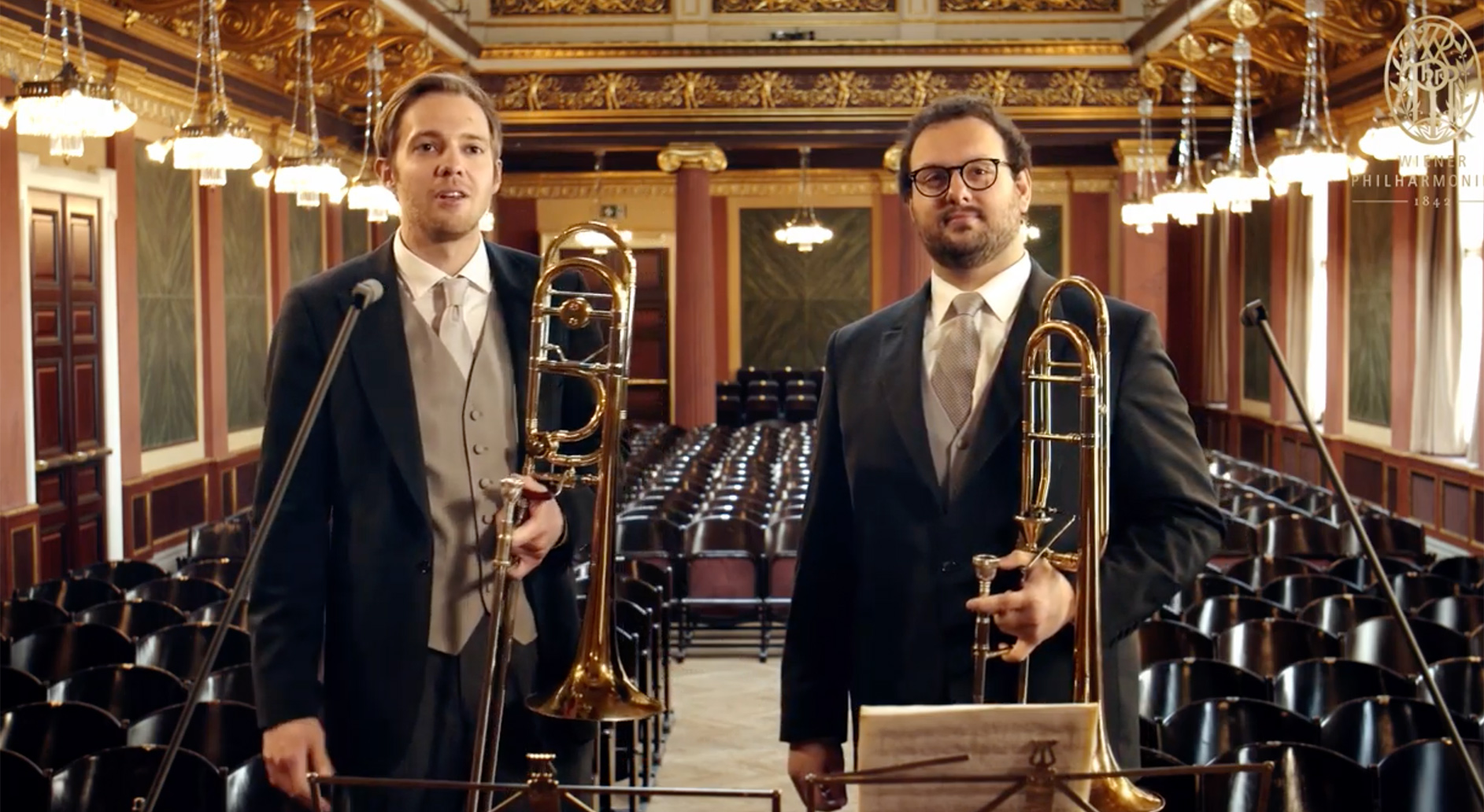
Enzo Turriziani, Principal Trombone of the Vienna Philharmonic
(Click on the image above for the concert video.)
Georg Philipp Telemann, Duet for Two Flutes, Sonata No. 2 in E Minor, TWV 40:102 Vivace, from the Six Sonatas
Written in 1726, this musical surprise brings us an unexpected and delightful interpretation by two trombones of Telemann’s ‘Duet for Two Flutes’, which is also frequently performed as a duet for violins. The Six Sonatas are written in the form of a church sonata and feature a dialogue between the two players.
Georg Philip Telemann (1680-1767) is one of the most prolific composers in history – he composed more works than Bach and Handel combined. From 1721 until his death at 87 in 1767, he was the director of music for Hamburg’s five main churches and musical director of the Opera. He organized many public concerts, wrote music for all major feasts, civic ceremonies, anniversaries and commemorations, published dozens of volumes of cantatas and sonatas for all instruments (some of which he engraved for printing himself), and managed the subscription sales throughout Europe of some of his major collections, notably his three sets of Musique de Table.
Telemann considered music to have a both a diplomatic and social function. He felt music should not be complicated and be accessible to all. He thought it should strive to unite human beings and nations and spread harmony among everyone. In his work as an editor, composer and organizer of events for his churches, his primary goal was to engage people in the joy of making and listening to music. Telemann wrote in all styles and was as curious and enthusiastic in his 80s as he was in his youth – he was always on the lookout for new trends. His view of art and his general philosophy of life embodied that of the enlightened and progressive middle class of his period. While this era found clear expression in melody, Telemann regarded harmony as the appropriate vehicle for heightened expression. His peers considered him a ‘master without equal’ and praised him for his cultivation, good humor and kindness – qualities that were reflected in his compositions which continue to enthrall audiences two hundred years later.
A Musical Holiday Greeting
Musicians: Rainer Honeck, Concertmaster and Anneleen Lenaerts, Principal Harp
Erich Wolfgang Korngold, Tanzlied des Pierrot, Op. 12 from Opera ‘Die tote Stadt’
Amy Beach, Three Compositions for Violin and Piano , Op. 40, II Berceuse’
This Holiday Greeting brings us the work of two child prodigies:
Erich Wolfgang Korngold (1897 – 1957) was an Austrian-born pianist, conductor and composer of classical music, along with music for Hollywood films, and the first composer of international stature to write Hollywood scores for which he won two Oscars.
When he was 11, his ballet Der Schneemann (The Snowman), became a sensation in Vienna, followed by his Second Piano Sonata which he wrote at age 13, played throughout Europe by Artur Schnabel. His one-act operas Violanta and Der Ring des Polykrates were premiered in Munich in 1916, conducted by Bruno Walter. At 23, his opera Die tote Stadt (The Dead City) premiered in Hamburg and Cologne.
Amy Marcy Cheney Beach (1867 – 1944) was an American composer and pianist. She was the first successful American female composer of large-scale art music. Her "Gaelic" Symphony, premiered by the Boston Symphony Orchestra in 1896, was the first symphony composed and published by an American woman. She was one of the first American composers to succeed without the benefit of European training, and one of the most respected and acclaimed American composers of her era. As a pianist, she was acclaimed for concerts she gave featuring her own music in the United States and in Germany.
She was able to sing forty songs accurately by age one, she was capable of improvising counter-melody by age two, and she taught herself to read at age three. At four, she composed three waltzes for piano during one summer at her grandfather's farm despite the absence of a piano; instead, she composed the pieces mentally and played them when she returned home. She could also play music by ear, including four-part hymns. Amy Cheney made her concert debut at age sixteen at Boston's Music Hall and the following year starred in the final performance of the Boston Symphony's 1884–85 season.
The Joy of Playing Together
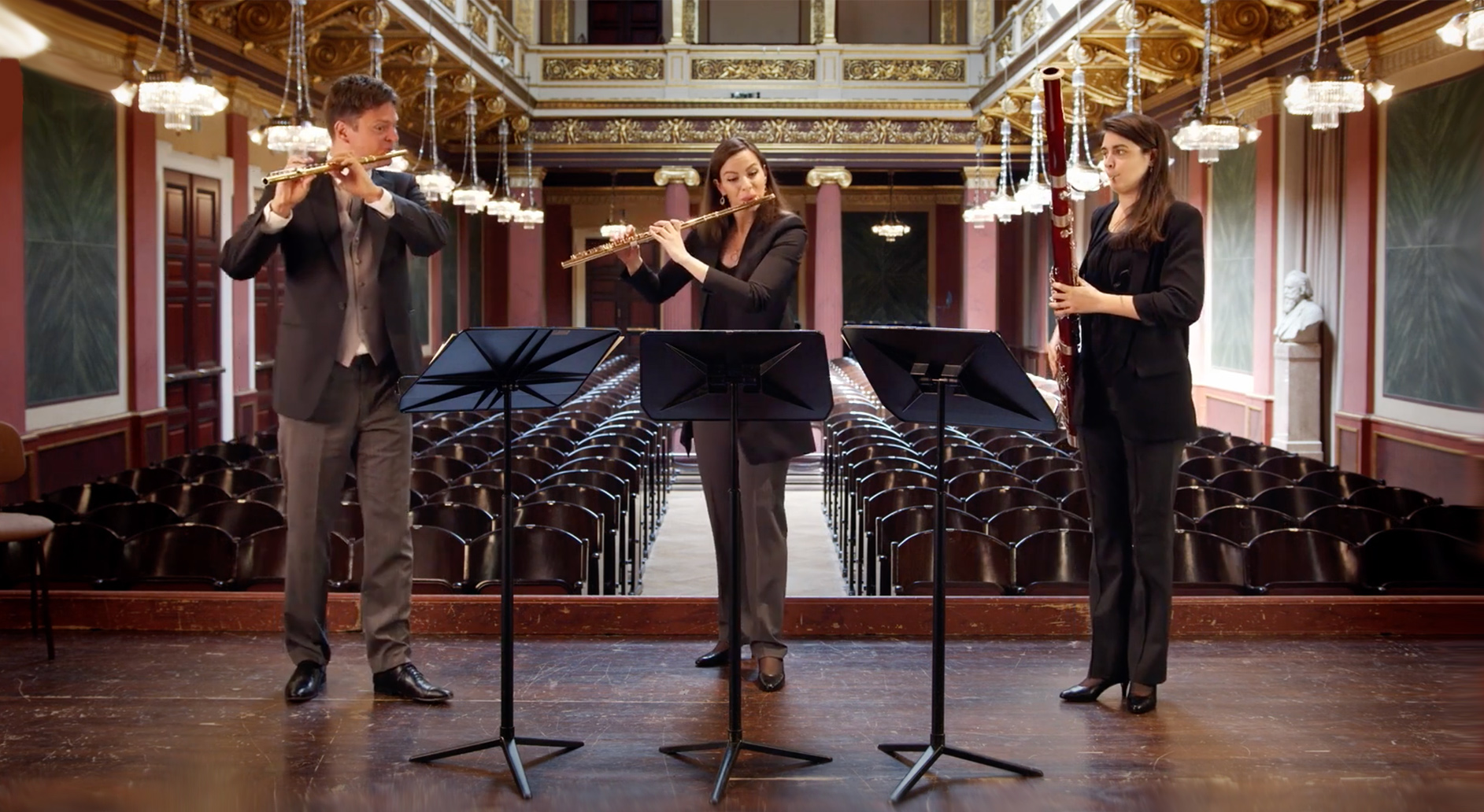
Joseph Haydn - London Trio No. 3 G major, Hob.IV:3; in three movements: Spiritoso, Andante; Allegro
Karl-Heinz Schutz, Principal Flute: “To play and perform one of the four famous London Trios by Joseph Haydn has been under a very special star-light during this season 2020! It is for sure one of the most delightful and cheerful pieces of music we have in our repertoire for the wind instruments. This Music is full of positivity and life!
This particular music by Joseph Haydn, written later in his life, is both, full of wisdom, elegance, spirit, and a glimpse of papa-Haydn-Humor! You may find all these ingredients and passions that we are of course permanently looking for in honest and good music-making and sharing with our audiences! Reawakening these emotions, encapsulated in the text of music, and make the audience feel them, is one of the most important missions we do have as an active musician!
A personal note to add about this recording would be to mention that to play these phrases and sounds together felt like an incredible relief for all three of us. It marked the first musical moment after the lockdown for us after all! It was the first time to reencounter beloved fellow-musicians and make music together after months. We all felt like being reborn!
It was an incredible feeling for us - not in full orchestra yet but in the intimate circumstances of chamber music. For all three of us, this has been an outstanding moment, and (fingers crossed!) concerning shutdowns, a hopefully only one-time experience in our musician's lives! Please enjoy and let yourself be carried away from everyday life by these sparkling sounds of music by Haydn!”
A Musical Conversation between the Flute and the Harp
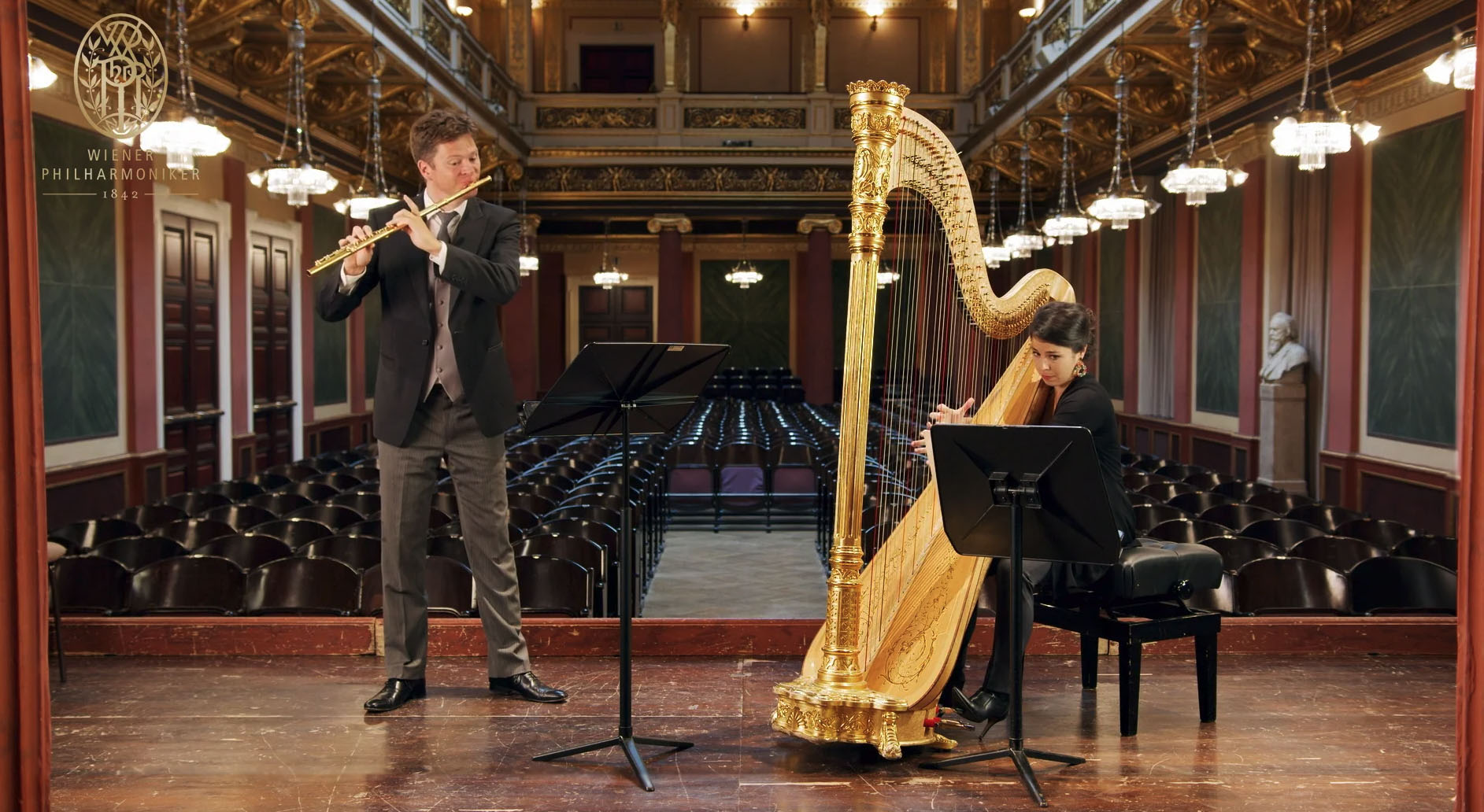
Nino Rota: Three movements from A Sonata for Flute and Harp
Karl-Heinz Schütz, Principal Flute: “The Sonata for Flute and Harp by the Italian composer Nino Rota is one of my favorites in my recitals. This music is full of expression, bright and intense in its colors, crystal clear in its form and proportions, like only a very classical sonata can be. But, before anything else, it is, of course, the sound - it is unique through its clothes in sound! It presents the romantic and ethereal sound-combination of both instruments at its best!
Rota’s music for me is sincere in its way of expression. It is singing to us in a very personal and direct way and aesthetically it keeps proportions almost as we know from very classical composers like Mozart or Haydn.
This music transports emotions directly to the listener and these emotions seem to emerge from another time, another life perhaps, somewhere from the past. It is lyrical and full of poetry and at the same time it is playful and so surprising at many corners. It is full of different characters and charm while at the same time it often spreads a certain melancholy by these long phrases, as we know them in a same idiom from tunes and melodies from film-music. Rota had written for famous movies directed by Fellini. Only music of the height of classical music allows this expectation. Here, the sonata creates its own plot, sense and inner pictures! ‘Prima La musica! Dopo le parole!‘ (First the music! Then the words!)
Last but not least, let me emphasize that we have been informed, that Nino Rota was the composition teacher of one of our most beloved conductors at the Vienna Philharmonic - Riccardo Muti!”
Bedřich Smetana: Má vlast, The Moldau – A Symphonic Poem
Má vlast, ‘My homeland’ in Czech language is a set of six symphonic poems composed between 1874 and 1879 by the Czech composer Bedřich Smetana. While it is often presented as a single work in six movements, the six pieces were conceived as individual works and were premiered separately beginning in 1875.
In these works, Smetana combined the symphonic poem form pioneered by Franz Liszt with the ideals of nationalistic music which were current in the late nineteenth century. Each poem depicts some aspect of the countryside, history, or legends of Bohemia.
Vltava, also known by its English title The Moldau, was composed in 1874 and premiered in 1875. In this piece, Smetana uses tone painting to evoke the sounds of one of Bohemia's great rivers. As Smetana described: ‘The composition describes the course of the Vltava, starting from the two small springs, the Cold and Warm Vltava, to the unification of both streams into a single current, the course of the Vltava through woods and meadows, through landscapes where a farmer's wedding is celebrated, the round dance of the mermaids in the night's moonshine: on the nearby rocks loom proud castles, palaces and ruins aloft. The Vltava swirls into the St John's Rapids; then it widens and flows toward Prague, past the Vyšehrad, and then majestically vanishes into the distance, ending at the Elbe.
A Musical Thank You to the Society from the Vienna Philharmonic Orchestra
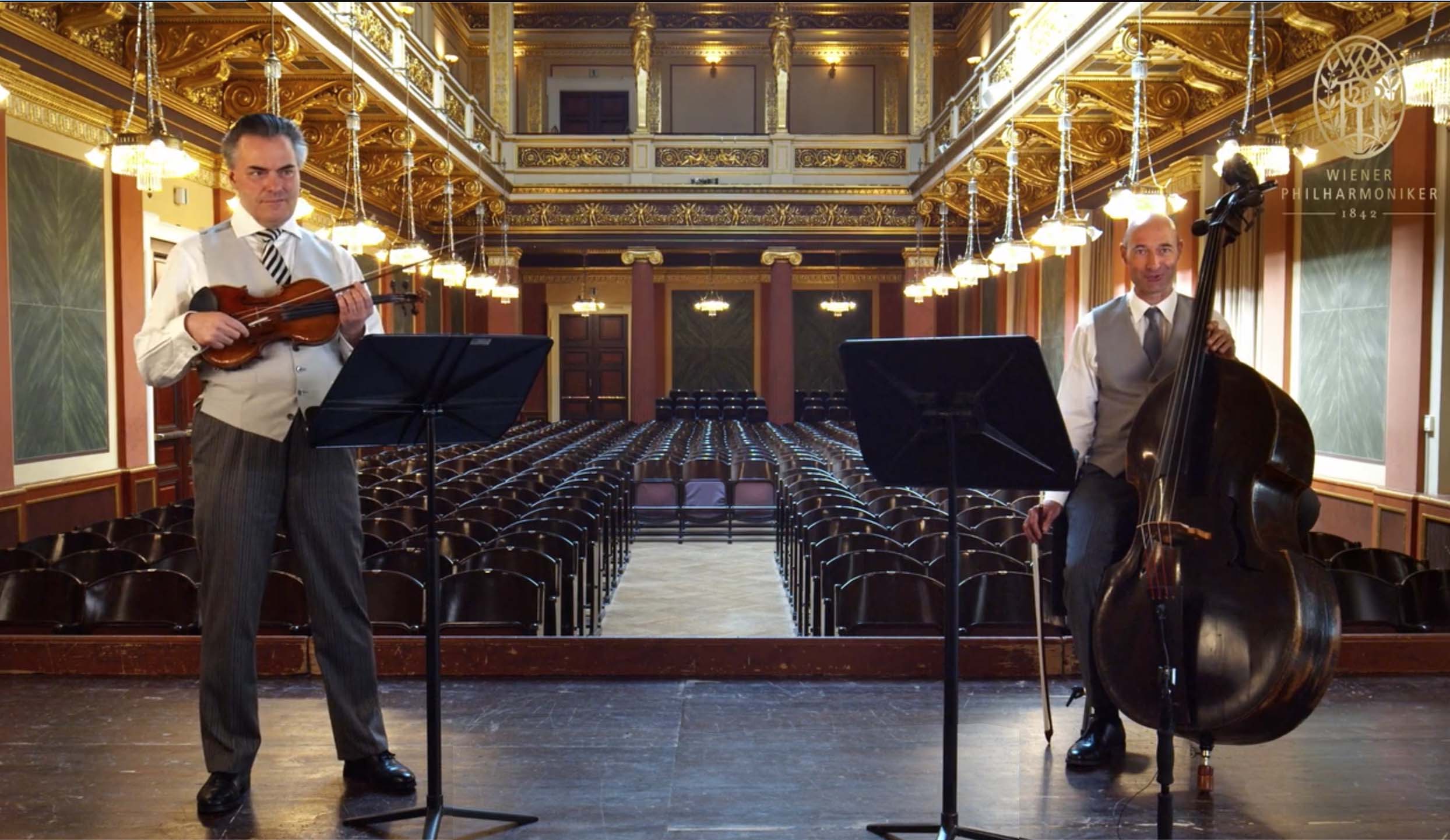
Reinhold Glière: Three movements from a suite for Violin and Double Bass (originally written for violin and cello)
Michael Bladerer, Bass, General Manager of the Orchestra: “The Russian composer Reinhold Glière (1875-1956) was a contemporary of Rachmaninov and teacher to Prokofiev. He originally wrote these duets for violin and cello. Since Daniel and I both teach at the Pacific Music Festival in Sapporo, we came across these duets when one of my double bass students performed them with a colleague. We liked them so much we felt we should perform them together one day. We have now finally studied three of the eight movements and are thrilled that they have been so well received.”
Johann Sebastian Bach: Sonata for Solo Violin in G Minor, 1st movement – Adagio
Daniel Froschauer, first violin, Chairman of the Orchestra: “Johann Sebastian Bach’s pieces for solo violin own a very special place in the repertoire. Written in the early 18th century, they have built a foundation which is as relevant to music making today as it was then. To me, the music of Bach is the law, which all other music refers back to in a way or another. His unaccompanied string works imply a polyphony, which requires a special technique. Both their technical and musical demands are incredibly high and set a lifelong challenge.”
Giovanni Bottesini: Melodia (for double bass and piano)
Michael Bladerer: “Giovanni Bottesini (1821-1889) was not only a celebrated Italian Romantic composer and a successful conductor, who worked closely together with Verdi and conducted the world premiere of his opera “Aida”. He was above all the most famous double bass virtuoso of his time, considered the “Paganini of the double bass”, and has set a high benchmark for double bass players until today. Needless to say, his music has always played an important part in my life. My teacher Ludwig Streicher was a wonderful interpreter of Bottesini’s music, and I am particularly fond of this piece. The style is so “cantabile” it reminds me of Verdi’s famous baritone arias.”